 By Admin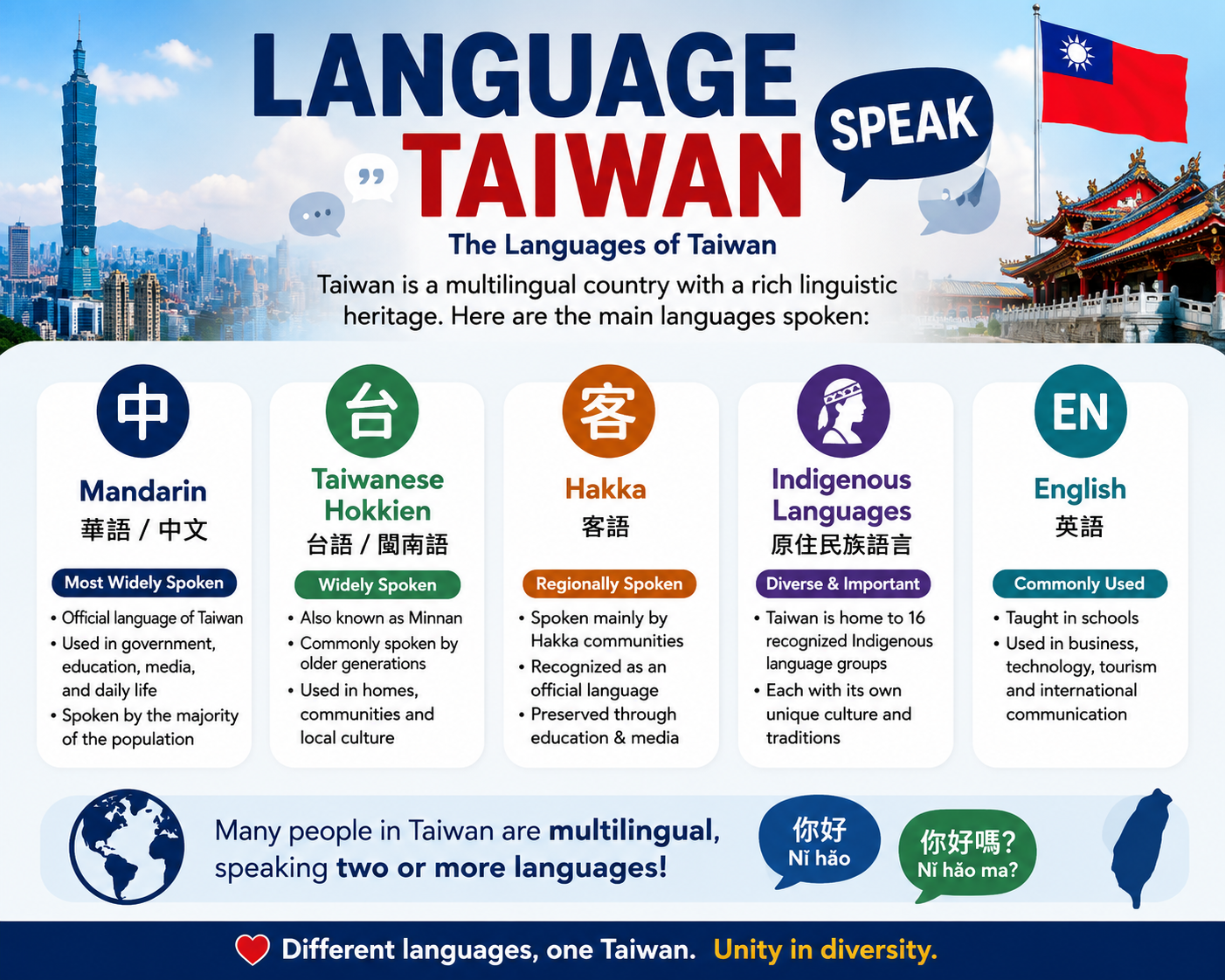
Have you ever wondered what language they speak in Taiwan? The answer is beautifully complex—like the island’s history itself. While Mandarin Chinese is the official language, Taiwan is home to a rich linguistic tapestry that includes Taiwanese Hokkien, Hakka, and indigenous Formosan languages. According to a 2020 government survey, approximately 66.3% of Taiwanese residents use Mandarin as their primary language, while 31.7% primarily speak Taiwanese Hokkien at home.
This comprehensive guide explores every facet of Taiwan’s linguistic landscape, answering what language Taiwan speaks and why the answer matters.
Table of Contents
ToggleWhat Language Do Taiwan People Speak?
When considering what language they speak in Taiwan, you’ll find that most people are bilingual or even trilingual. The island’s multilingualism reflects its cultural diversity and historical journey.
Quick answer: Mandarin Chinese is the official language spoken by nearly everyone, but Taiwanese Hokkien is the most widely spoken native language. Hakka and indigenous languages also play significant roles.
Let’s explore each of these languages in detail.
The Official Language: Taiwanese Mandarin (Guóyǔ)
What Is Taiwanese Mandarin?
The primary language Taiwan speaks in official settings is Mandarin Chinese, locally referred to as Guóyǔ (國語, “national language”) or Huáyǔ (華語, “Chinese language”) . It’s the language of government, education, media, and formal communication.
History of Mandarin in Taiwan
Mandarin wasn’t always the dominant language Taiwan speaks:
-
Before 1945: Japanese was the official language during Japan’s 50-year colonial rule (1895-1945)
-
1945: Following World War II, the Republic of China introduced Mandarin as the official language
-
1940s-1980s: Mandarin was promoted heavily in schools and media, with local languages suppressed
-
Present day: Mandarin is the lingua franca, spoken by virtually all Taiwanese under age 60
How Taiwanese Mandarin Differs from Mainland Chinese
The language used in Taiwan has distinct characteristics that set it apart from the Mandarin spoken in mainland China:
| Feature | Taiwanese Mandarin (Guóyǔ) | Mainland Mandarin (Pǔtōnghuà) |
|---|---|---|
| Writing system | Traditional Chinese characters | Simplified Chinese characters |
| Pronunciation | Softer, less retroflex (zh, ch, sh → z, c, s) | Distinct retroflex sounds |
| Erhua | Rarely used | Common in northern China |
| Vocabulary | Includes Hokkien and Japanese loanwords | Different terms for many concepts |
| Tonal qualities | Somewhat different tonal qualities | Standard Beijing-based tones |
Example vocabulary differences:
-
“Pineapple”: Taiwanese Mandarin says fènglí (鳳梨), while Mainland Mandarin says bōluó (菠蘿)
-
“Scooter”: Taiwanese Mandarin uses mótuōchē (摩托車)
How Many People Speak Mandarin in Taiwan?
Mandarin proficiency in Taiwan is remarkably high:
-
4.6 million native speakers (first language)
-
15 million second-language speakers
-
21 million total speakers as of 2020
-
Over 80% of people in northern Taiwan (Taipei, Taoyuan, Hsinchu) use Mandarin as their primary language
Younger generations are particularly fluent in Mandarin. In 2020, over two-thirds of Taiwanese over 65 used Hokkien or Hakka as their primary language, compared with just 11% of 15-24-year-olds.
The Most Widely Spoken Native Language: Taiwanese Hokkien (Tâi-gí)
What Language Do Taiwanese People Speak at Home?
If you ask “what language do people speak in Taiwan” in everyday life, many will answer Taiwanese Hokkien, commonly called “Taiwanese” (臺語 / Tâi-gí). While Mandarin is the official language, Taiwanese is the mother tongue of about 70% of the population.
Key Facts About Taiwanese Hokkien
-
Language family: Southern Min (Minnan), originating in Fujian province, China
-
Number of speakers: ~15 million people speak Taiwanese
-
Primary usage: Home life, informal settings, local media, popular music
-
Mutual intelligibility: Similar to Hokkien spoken in Fujian and Southeast Asia, but not mutually intelligible with Mandarin
Historical Context
Until the 1980s, the use of Taiwanese was banned in schools and restricted in media by the Kuomintang administration . The government portrayed local languages as inferior, leading to a significant decline in usage. However:
-
Restrictions have since been lifted
-
Taiwanese is now taught as a subject in some schools
-
Taiwanese broadcasts are now common
-
Some companies have adopted Taiwanese as their official language
Cultural Revival
In recent years, there has been a vibrant movement—especially among young people—to revive Taiwanese. Social media stars, musicians, and cultural advocates are reexamining identity through the Taiwanese language. This reflects growing concerns about preserving linguistic heritage.
The Hakka Language
Who Speaks Hakka?
The Hakka people, who migrated from Guangdong and Fujian provinces, maintain their distinct language. About 15-20% of Taiwan’s population speaks Hakka to varying degrees.
Key Characteristics
-
Language family: Sino-Tibetan, related to both Cantonese and Mandarin
-
Main dialects in Taiwan: Sixian (four-county) and Hailu (seaport)
-
Regional concentration: Several counties throughout Taiwan, particularly in the north and south
Government Support
The Taiwanese government has established:
-
Hakka TV and radio stations
-
Hakka language classes in schools
-
Preservation and promotion programs
Indigenous Formosan Languages
What Languages Did Taiwan Speak First?
Before any Chinese languages arrived, Taiwan’s indigenous peoples spoke Formosan languages for thousands of years. In fact, Taiwan is considered the Urheimat (homeland) of the Austronesian language family.
Current Status
Today, indigenous peoples comprise about 2-2.3% of Taiwan’s population. However, far fewer can speak their ancestral languages after centuries of language shift.
Key facts:
-
~26 Formosan languages known
-
At least 10 are extinct
-
5 are moribund
-
Others are endangered to varying degrees
Recognized Indigenous Languages
The government recognizes 16 languages and 42 accents of indigenous languages:
| Language | Speaker Population (approx.) |
|---|---|
| Amis | Most widely spoken; ~200,000 ethnic Amis, but fewer than 10,000 first-language speakers |
| Atayal | ~80,000 |
| Bunun | ~38,000 |
| Paiwan, Puyuma, Rukai, Tsou, Saisiyat, Thao, Kavalan, Sakizaya, Truku, Seediq, Kanakanavu, Saaroa, Tao | Varying populations |
Revitalization Efforts
In recent decades, the government has:
-
Started an aboriginal reappreciation program
-
Reintroduced Formosan mother tongue education in schools
-
Established Taiwan Indigenous Television and Alian 96.3 radio
-
Passed the Indigenous Languages Development Act
-
Created digital learning platforms for indigenous languages
Unfortunately, results have been disappointing despite these efforts .
Historical Influences: Japanese
Why Is Japanese Relevant?
Because Japan ruled Taiwan for 50 years (1895-1945), Japanese was compulsory in schools and public life.
Current Usage
Today, Japanese fluency is limited primarily to:
-
Elderly Taiwanese educated before 1945
-
People involved in cultural or commercial relations with Japan
-
Younger generations influenced by Japanese pop culture
As scholar Gregory W. Noble noted in 2005, “Few Taiwanese under age sixty-five speak Japanese well” . However, Japan remains culturally influential, and many Taiwanese still study Japanese .
Loanword Influence
Japanese has left a lasting mark on other languages Taiwan speaks:
-
Taiwanese Hokkien incorporates numerous Japanese loanwords
-
Taiwanese Mandarin includes Japanese-derived vocabulary
-
Formosan languages also contain Japanese loanwords
English and Other Foreign Languages
English in Taiwan
-
Compulsory in elementary school and beyond
-
Featured on education exams
-
Common in large private schools offering English instruction
-
Used in tourist areas and international settings
Southeast Asian Languages
Recent immigration has brought new languages Taiwan speaks:
-
Vietnamese and Indonesian are spoken in immigrant communities
-
This reflects Taiwan’s growing global connections
Comparison Table: Languages in Taiwan
| Language | Speaker Population | Writing System | Mutual Intelligibility with Mandarin | Official Status |
|---|---|---|---|---|
| Mandarin | ~21 million total | Traditional Chinese | N/A | Official |
| Taiwanese Hokkien | ~15 million | Traditional Chinese / Latin script (POJ) | No | National language |
| Hakka | 15-20% of population | Traditional Chinese | Limited | National language |
| Formosan languages | ~2% of population (limited fluency) | Latin script | No | Official recognized |
| Japanese | Limited (elderly, enthusiasts) | Japanese script | No | Historical |
| English | Widely learned | Latin alphabet | No | Foreign language |
Step-by-Step Guide: Understanding Taiwan’s Language Landscape
For travelers, students, or business professionals asking “what language do you speak in Taiwan,” follow this guide:
1: Learn some Mandarin
-
Mandarin will get you through formal situations, government offices, and with younger people
-
Focus on phrasebook basics for tourists
2: Listen for Taiwanese Hokkien in informal settings
-
Night markets, local restaurants, and older generations often use Taiwanese
-
Even if you don’t speak it, recognizing it helps navigate daily life
3: Acknowledge the diversity
-
Beyond Taipei, you’ll encounter Hakka and indigenous languages
-
Different regions have different dominant languages
4: Use English when needed
-
In Taipei and tourist areas, many people speak basic English
-
However, don’t rely on it outside major cities
5: Understand the written language
-
All official documents use Traditional Chinese characters
-
Signs are often bilingual (Mandarin, sometimes English, occasionally Japanese)
Best Practices for Visitors and Learners
Travelers
-
Learn a few Mandarin phrases—effort is appreciated
-
Use translation apps—Google Translate supports Traditional Chinese
-
Note that Hokkien is rarely written; you won’t find maps in Taiwanese
Language Learners
-
Learn Mandarin first—it’s the most practical choice
-
For deeper cultural immersion, learning Taiwanese Hokkien opens doors
-
Hakka and indigenous languages are niche but fascinating options
Business Professionals
-
Mandarin is essential for business communication
-
Some business contexts may include Taiwanese and Japanese
-
Written communication uses Traditional Chinese characters
Common Mistakes to Avoid
1: Assuming Everyone Speaks the Same Language
Reality: Taiwan is multilingual. Mandarin and Taiwanese are both widely used, and code-switching between them is common.
2: Thinking Taiwanese Mandarin Is the Same as Mainland Mandarin
Reality: While mutually intelligible, there are significant differences in pronunciation, vocabulary, and writing systems.
3: Calling Taiwanese a “Dialect” of Mandarin
Reality: Taiwanese Hokkien and Mandarin are not mutually intelligible. They belong to different branches of the Sinitic language family .
4: Assuming Everyone Writes n Simplified Chinese
Reality: Taiwan uses Traditional Chinese characters, not simplified. This is a visible difference even for non-speakers.
5: Overlooking Indigenous Languages
Reality: Indigenous languages are part of Taiwan’s linguistic heritage, though endangered. Taiwan is globally significant as the origin of the Austronesian language family.
Expert Tips
-
Code-switching is normal: Don’t be surprised if you hear people switch between Mandarin and Taiwanese mid-sentence
-
Regional differences matter: Mandarin is more prevalent in northern Taiwan (especially Taipei), while Taiwanese Hokkien is more common in the south
-
Taiwanese Mandarin exists on a spectrum: From “Standard Guóyǔ” (formal, official) to “Taiwan Guóyǔ” (colloquial, with heavy Hokkien influence)
-
Japanese loanwords are everywhere: Even if you don’t speak Japanese, you’ll notice its influence in vocabulary across languages Taiwan speaks
-
Linguistic identity is complex: How people describe their language often reflects deeper political and cultural views
Pros and Cons of Taiwan’s Multilingual Landscape
Pros
-
Rich cultural heritage reflected in diverse languages
-
Global connectivity through multiple language resources
-
National identity strengthened through language revival movements
-
Linguistic research value (especially Austronesian origins)
Cons
-
Endangered indigenous languages losing speakers rapidly
-
Generational gaps: Younger people increasingly speak only Mandarin
-
Historical language suppression caused lasting damage
-
Political tensions over language choice and identity
Future Trends in Taiwan’s Language Landscape
What’s Next for Languages Taiwan Speaks?
1. Continued Mandarin Dominance
-
Mandarin will likely remain the primary language for most Taiwanese
-
Younger generations are fluent in Mandarin, with local languages less used
2. Revival Movements
-
Taiwanese Hokkien is seeing grassroots revival among young people
-
Hakka and indigenous language preservation efforts continue, though effectiveness varies
3. Digital Transformation
-
Online dictionaries, apps, and digital learning platforms now support Taiwanese Hokkien
-
Tech is making language learning more accessible
4. Increased English Proficiency
-
As Taiwan engages more globally, English education will likely expand
5. Linguistic Identity Tensions
-
Debates about language and national identity may continue
-
Code-switching will remain a defining feature of daily communication
Conclusion
So, what language does Taiwan speak? The answer is far from simple—and that’s what makes it fascinating. Taiwanese Mandarin is the official language and lingua franca, but it exists alongside Taiwanese Hokkien (the most widely spoken native language), Hakka, and the endangered yet historically significant Formosan indigenous languages.
Understanding that Taiwan is multilingual helps appreciate its unique cultural identity. The answer to “what language do Taiwanese people speak” depends on who you’re asking, where you are, and what generation they belong to. Mandarin will serve you well in most situations, but the island’s true linguistic richness lies in the languages that tell its complex story.
Key Takeaways
-
Mandarin Chinese (Guóyǔ) is Taiwan’s official language and lingua franca
-
Taiwanese Hokkien (Tâi-gí) is the most widely spoken native language (~70% of population)
-
Hakka is spoken by 15-20% of the population
-
Formosan indigenous languages are linguistically significant but endangered
-
Taiwan uses Traditional Chinese characters, not simplified
-
Taiwanese Mandarin differs from Mainland Mandarin in pronunciation, vocabulary, and writing
-
Japanese influence remains in vocabulary across all languages
-
English is widely taught but not widely spoken fluently
-
Multilingualism and code-switching are daily realities
Sources
-
Languages of Taiwan. (2011). National Library Board Singapore.
-
Taiwanese Mandarin. (2006). Wikipedia.
-
Formosan Languages. (2005). Wikipedia.
-
Cantonese and Mandarin in Hong Kong and Taiwan. Omniglot.
-
Taiwanese Mandarin. (2020). Wikipedia.
-
Taiwanese (臺語 / Tâi-gí). (2025). Omniglot.
-
About Taiwan. (2026). Taiwan.gov.tw.
-
Taiwan. (2026). Encyclopedia Britannica.
-
Languages Spoken in Taiwan. (2025). Overseas Joint Admissions Committee.
-
A Language Identity: Taiwan. NHK World-Japan.
-
Languages of Taiwan. Wikipedia.
-
Bunun language. Wikipedia.
-
Languages of Taiwan. (2013). National Library Board Singapore.
-
Table 1: Population statistics of Taiwanese ethnic groups. NIH/NLM.
FOR FURTHER INFORMATION, VISIT: THESOLOMAG.CO.UK