 By Admin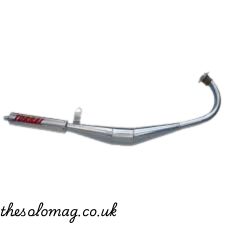
If you are lucky enough to own or hear a Yamaha RD motorcycle, you know it is a sensory event. The smell of premix, the aggressive vibration, and that sound—a signature high-pitched “ring-ding” that turns heads faster than almost any modern superbike.
At the heart of this iconic machine lies a component that is often misunderstood: the Escapamento RD.
In Portuguese, “escapamento” simply means exhaust. But in the world of two-stroke performance, the RD exhaust is not just a pipe; it is the brain of the engine. Unlike four-stroke motors, a Yamaha RD125, RD200, or the legendary RD350 literally cannot function optimally without a precisely tuned exhaust system.
In this guide, we will dive deep into the engineering of the expansion chamber, how to choose between stock and performance pipes, and the crucial tuning steps you must take after an upgrade.
What is the Escapamento RD?
The term “Escapamento RD” specifically refers to the exhaust systems designed for the legendary Yamaha RD series . Produced primarily in the 1970s and 1980s, the RD (which stands for “Race Developed”) line includes beloved bikes like the RD125, RD200, RD250, and the monstrous RD350 (including the LC and YPVS variants).
While most exhausts are designed to simply quiet noise and route gases away, the Escapamento RD is a performance tool. It utilizes a specific shape—featuring a divergent cone, a belly, and a convergent cone—known as an expansion chamber .
The Engineering Secret: How the Expansion Chamber Works
To understand why your RD feels slow with a hole in the muffler, you need to understand the “overlap” in two-stroke engineering.
In a four-stroke engine, valves direct the flow of gas. In a two-stroke, the piston uncovers ports in the cylinder wall. As the piston descends, it opens the exhaust port. Naturally, the fresh fuel/air mixture entering the cylinder wants to go straight out the exhaust port (this is called “short-circuiting”).
Here is where the Escapamento RD works its magic :
-
The Pulse: The burning gas exits the cylinder and enters the expansion chamber.
-
The Return: When that pulse hits the convergent cone (the narrowing end of the chamber), it creates a powerful reverse pressure wave—a sonic boom of sorts—that travels back to the cylinder.
-
The Plug: This wave arrives just before the piston closes the exhaust port, shoving the escaping fresh fuel back into the cylinder.
-
The Result: You get more power, better efficiency, and the iconic high-revving “hit” that RD riders live for.
Because of this dynamic, the exhaust is a tuning component. Changing the length or shape of the pipe changes where in the RPM range that power hits .
Original vs. Performance: Which Exhaust is Right for You?
When restoring or modifying your RD, you generally face three paths regarding the Escapamento RD.
The Original Equipment (Stock) Exhaust
If you are restoring a classic to concours standards, original pipes are gold.
-
Pros: They offer a smooth, torquey power delivery. They are quieter and street-legal in most jurisdictions. They are built with thick steel that lasts decades.
-
Cons: They are heavy and restrictive. Finding a rust-free original set for an RD350, for example, can cost a small fortune.
Performance Aftermarket Exhaust
Companies like Arrow, GPR, Laser, and JL Exhausts have built businesses around the RD platform .
-
Pros: Significant horsepower gains (often 5-10+ HP on an RD350), substantial weight reduction, and an aggressive, race-ready sound.
-
Cons: They are loud. They often shift the power band to the top-end (sacrificing low-end grunt for high-RPM scream).
Custom/Handmade Systems
For the serious builder, handmade pipes designed on a dyno are the holy grail.
-
Pros: Tailored specifically to your engine displacement, porting, and carburetion.
-
Cons: Expensive and requires expert tuning knowledge.
The “Must-Do” List: The Danger of “Slap-On” Upgrades
Here is the most important lesson for any RD owner: Do not just bolt on chambers and ride.
Because the Escapamento RD changes the scavenging and cylinder filling properties, it directly alters the air/fuel ratio. If you install a free-flowing performance exhaust without adjusting the carburetors, your engine will run lean (too much air, not enough fuel). Lean conditions create extreme heat, which leads to the ultimate two-stroke nightmare: Seizure.
Case Study: The Beer Can Jetting Trick
One classic method for tuning a modified RD involves cutting up beer cans. As documented by Classic Bike Magazine, tuners slide aluminum can sleeves over pod filters and trim them back at the roadside to effectively increase or decrease restriction, adjusting the jetting “on the fly” until the engine runs clean—before ordering the correct jets .
To safely upgrade your Escapamento RD, follow this checklist:
-
Jetting: You will almost certainly need larger main jets.
-
Plug Chop: You must learn how to read spark plugs (looking for a “biscuit brown” insulator color) .
-
Air Filters: If you switch to foam pod filters, the jetting changes drastically from the stock airbox.
-
Timing: On highly modified RDs, ignition timing may need to be adjusted.
The Sound of Speed
Why do we obsess over the Escapamento RD? The sound.
A stock RD is relatively polite, but a bike fitted with performance chambers produces a sound that is impossible to replicate. It is metallic, sharp, and frantic. It sounds like a 500cc Grand Prix bike from the 1970s.
The sound is a direct byproduct of the expansion chamber physics. The pressure waves and the unique resonance of the “stinger” (the small tailpipe) create that snappy, crackling tone that distinguishes an RD from a modern four-stroke .
Common Installation Issues
As seen in various owner forums, fitting aftermarket pipes is rarely a bolt-on affair :
-
Clearance: Aftermarket pipes often clash with center stands, aftermarket swingarms, or rear brake pedals.
-
Vibration: Two-strokes vibrate. Ensure mounting brackets are rubber-mounted or reinforced to prevent cracking.
-
Material: Look for systems made of 304 Stainless Steel or coated mild steel to prevent rust. Avoid cheap, unbranded expansion chambers that are welded poorly .
How to Clean and Maintain Your Exhaust
If you buy a barn-find RD, the pipes are likely full of carbon and “muck.” To restore performance:
-
The Burn: Use a torch or a hot fire (safely) to burn the carbon buildup inside the chamber into ash. This is messy but effective.
-
Oven Cleaner: For lighter cleaning, spray heavy-duty oven cleaner inside the pipes, let it sit, and pressure wash it out .
-
Repacking: If your silencer has rivets, drill them out, replace the fiberglass packing, and re-rivet. This quiets the bike and improves performance.
Conclusion: Respect the Machine
The Escapamento RD is a testament to a wilder era of motorcycling. In a world of homogenized, silent electric scooters and sterile sportbikes, the crackle of an RD350 on full song is a rebellion.
Whether you choose to preserve the original pig iron pipes for authenticity or fit a set of hand-coned expansion chambers for maximum power, remember that on a two-stroke, the exhaust is everything. If you tune it with respect—and re-jet accordingly—the RD will reward you with a riding experience that is raw, visceral, and utterly addictive.
Frequently Asked Questions (FAQs)
1. Can I run my RD without a muffler (just the expansion chamber)?
Technically yes, but it is not recommended. Running an Escapamento RD without a stinger or muffler (an “open header”) destroys the expansion chamber effect. You will lose low-end torque, the bike will be unbearably loud (causing hearing damage and police attention), and you risk burning your exhaust valves or melting your plastic side panels due to intense heat. Always run a proper silencer.
2. Will an aftermarket Escapamento RD damage my engine?
Only if you ignore jetting. The exhaust itself does not damage the engine. However, lean air/fuel mixtures caused by free-flowing chambers will cause piston seizure. Always re-jet your carburetors and perform a plug chop after installing performance pipes. With correct tuning, aftermarket exhausts are perfectly safe and actually improve engine cooling.
3. How do I identify a genuine Yamaha RD exhaust vs. a replica?
Genuine Yamaha exhausts have stamped part numbers (e.g., 1A2, 4L0, 351) on the mounting brackets or flanges. They also feature heavy-gauge steel with welded seams and original heat shields. Replicas often lack markings, use thinner metal, and have imperfect welds. Factory pipes also have internal baffles, while most replicas are straight-through expansion chambers.
4. What is the best Escapamento RD for street riding?
For a balance of performance and rideability, the JL Exhausts GP system or Arrow chambers are excellent choices. They provide a strong mid-range punch without sacrificing too much low-end torque. If you prefer a quiet, smooth ride, rebuild your original stock exhaust using new packing and decarb the internals.
5. Why does my RD350 sound like it’s “hitting a wall” at high RPM?
That “wall” is a tuning mismatch. Common causes include: main jets that are too small (lean seizure warning), an expansion chamber designed for low-RPM torque that restricts top-end flow, or a clogged stinger/muffler. Conversely, a sudden power surge (the famous “powerband hit”) is normal for RD pipes—the wall should be a smooth spike, not a cutout.
6. How often should I repack my RD exhaust silencer?
For street riding, repack every 5,000 to 8,000 miles or every two years. For track or aggressive riding, repack annually. Signs you need repacking: excessive noise, oil dripping from the silencer joint, or visible fiberglass pieces exiting the tailpipe. Use high-temperature two-stroke packing material (not household insulation).
7. Can I use an RD400 exhaust on my RD350?
Physically, yes on many models—the flange spacing is similar. However, the RD400 has a different cylinder port timing and displacement. An RD400 pipe on an RD350 will shift the powerband lower (more torque) but reduce top-end horsepower. The reverse (RD350 pipe on RD400) causes severe overheating. Always use model-specific pipes unless you are dyno-tuning.
8. What causes blue or purple discoloration on my expansion chamber?
That rainbow-blue color is normal and actually desirable. It indicates the pipe is made from stainless steel or high-quality mild steel, and the heat from exhaust gases has caused surface oxidation. It does not affect performance. Rust or black peeling paint indicates cheap material or corrosion. To remove blueing, use metal polish and a high-speed buffer—but most riders keep it as a badge of honor.
9. Where can I buy a new Escapamento RD in 2025/2026?
Specialist suppliers include:
-
JL Exhausts (UK) – Handmade, best for RD350.
-
Arrow Special Parts (Italy) – High-quality bolt-on kits.
-
GPR Exhausts (Italy) – Road-legal options with removable baffles.
-
Economy Cycle (USA) – Distributor for multiple brands.
-
Yambits (UK) – Excellent stock-style replicas.
Avoid unbranded eBay pipes—they rarely fit without heavy modification.
10. Does the length of the expansion chamber matter?
Absolutely. Longer pipes (from header to stinger) produce power at lower RPMs (torque). Shorter pipes produce power at higher RPMs (horsepower). This is why drag racing RDs have stubby, short chambers, while street bikes have longer, fatter pipes. Never cut or shorten an Escapamento RD unless you have a dyno and pipe design software—you will ruin the tuned length and lose all performance.
FOR FURTHER INFORMATION, VISIT: THESOLOMAG