 By Admin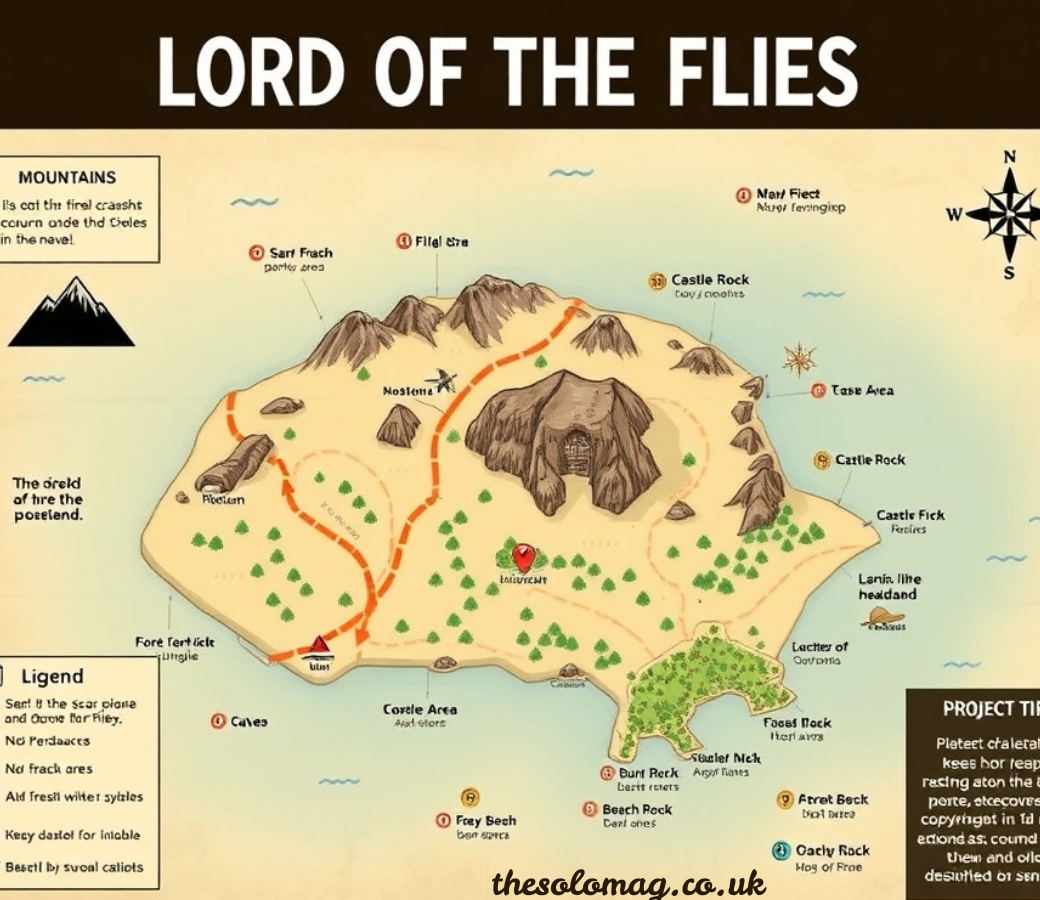
Introduction
The island in Lord of the Flies is more than just a setting. It plays a major role in the story. The island shapes the boys’ behavior, creates fear, and reflects the struggle between civilization and savagery.
Many readers search for the “Lord of the Flies island map” to better understand where important events happen. From the mountain and beach to the lagoon and forest, every location has meaning.
In this article, you will learn about:
- The full island layout
- Important places on the island
- Symbolism behind each location
- How the map connects to the story
- Frequently asked questions
Overview of the Lord of the Flies Island
The island is a tropical, uninhabited place where a group of boys become stranded after a plane crash during a war.
William Golding never provides an official map in the novel. However, readers and scholars have recreated the island based on descriptions from the book.
The island includes:
- A beach and lagoon
- Dense jungle
- A mountain
- Hunting grounds
- A platform near the shore
- The crash site
- Castle Rock
- Forest areas
These locations help explain the movement of the boys throughout the story.
Main Locations on the Lord of the Flies Island Map
1. The Beach and Lagoon
The beach is one of the first places the boys gather after the crash. It represents safety, order, and civilization.
Important events here include:
- Ralph finding the conch shell
- The first assembly
- Building shelters
- Early attempts at cooperation
The lagoon area is calm and beautiful. At the beginning, the boys believe the island is like paradise.
Symbolism of the Beach
The beach symbolizes:
- Democracy
- Hope
- Structure
- Human civilization
As the story progresses, the beach becomes less important because the boys slowly abandon order.
2. The Mountain
The mountain is located at the center or highest point of the island. The boys use it to keep the signal fire burning.
The signal fire is their only chance for rescue.
However, several important problems happen here:
- The fire goes out
- A dead parachutist lands on the mountain
- The boys mistake the parachutist for the “beast”
Symbolism of the Mountain
The mountain represents:
- Hope for rescue
- Fear
- Confusion
- The loss of rational thinking
The higher area also creates distance from safety and order.
3. The Jungle and Forest
The jungle covers most of the island. It becomes darker and more dangerous as the story continues.
The boys enter the forest mainly for:
- Hunting pigs
- Exploring
- Hiding
- Escaping fear
The jungle is where Jack and his hunters become more savage.
Symbolism of the Forest
The forest symbolizes:
- Fear of the unknown
- Human darkness
- Savagery
- Chaos
It contrasts strongly with the peaceful beach.
4. Castle Rock
Castle Rock is a rocky area on one side of the island. Jack later uses it as his headquarters.
This location becomes dangerous and violent.
Important events at Castle Rock include:
- Jack forming his tribe
- The torture of Samneric
- Piggy’s death
- The theft of Piggy’s glasses
Symbolism of Castle Rock
Castle Rock represents:
- Power
- Violence
- Dictatorship
- Complete savagery
It becomes the opposite of Ralph’s civilized leadership.
5. The Platform
Near the beach is a rocky platform where the boys hold meetings.
This location is important because:
- Ralph uses the conch there
- Rules are discussed
- The group tries to maintain order
The platform works like a government meeting place.
Symbolism of the Platform
The platform symbolizes:
- Law
- Communication
- Civilization
- Democracy
As fear grows, fewer boys respect the meetings.
6. The Crash Site
The plane crash area reminds the boys that they are trapped.
At first, the boys focus on survival and rescue. Later, many forget rescue completely and become obsessed with hunting and power.
The crash site represents:
- Lost innocence
- Isolation
- Human vulnerability
Simple Layout of the Lord of the Flies Island Map
Here is a basic idea of the island’s structure:
| Island Area | Purpose in the Story |
|---|---|
| Beach & Lagoon | Meetings, shelters, safety |
| Platform | Assemblies and rules |
| Mountain | Signal fire and fear |
| Jungle | Hunting and savagery |
| Castle Rock | Jack’s tribe and violence |
| Forest Paths | Exploration and danger |
Why the Island Map Is Important
The island map helps readers understand how the story develops.
Each location reflects emotional and psychological changes in the boys.
For example:
- Open spaces represent civilization.
- Dark forests represent fear and evil.
- High places represent hope and danger.
- Isolated places represent violence and chaos.
The movement across the island mirrors the boys’ transformation.
Themes Connected to the Island
Civilization vs Savagery
The island divides civilized spaces from savage spaces.
- The beach and platform represent order.
- The jungle and Castle Rock represent savagery.
This contrast is one of the novel’s main themes.
Fear and Imagination
The unknown parts of the island create fear.
The boys imagine monsters and beasts because they do not fully understand their environment.
The island becomes psychologically frightening.
Loss of Innocence
At first, the island seems exciting and beautiful.
Over time, it becomes violent and terrifying. This change reflects the boys losing their innocence.
Is There an Official Lord of the Flies Island Map?
There is no official map drawn by William Golding. However, many editions of the novel include fan-made or publisher-created maps.
These maps are based on descriptions from the text.
Readers often use these maps to:
- Follow character movement
- Understand key scenes
- Study symbolism
- Prepare for exams and essays
Educational Importance of the Island Map
Students often study the island map because it helps explain:
- Character development
- Symbolism
- Themes
- Conflict
- Plot progression
Teachers also use island diagrams in literature classes to simplify the story structure.
Conclusion
The island in Lord of the Flies is one of the most important elements of the novel. Every major location has symbolic meaning and influences the boys’ actions.
The beach represents civilization and hope. The jungle represents fear and savagery. Castle Rock shows the rise of violence and dictatorship.
Understanding the Lord of the Flies island map helps readers better understand the novel’s deeper meaning and themes.
FAQS
1. Does William Golding ever provide an official map in the book?
No. Golding deliberately chose not to include an official map. He wanted readers to build the island in their own imaginations alongside the boys. However, his descriptive text is so precise that scholars and artists have created consensus maps that are widely accepted as accurate.
2. What shape is the island?
Golding explicitly describes the island as “roughly boat-shaped.” It has a pointed end (where Castle Rock sits) and a rounded hump at the other end (where the mountain is located). Some readers also describe it as looking like a porpoise or a fish when viewed from above.
3. What is the most important landmark on the map?
It depends on your lens, but most scholars agree on two: The Mountain (home of the signal fire and truth) and The Platform (home of the conch and democracy). However, Castle Rock is the most symbolically powerful landmark because it represents the final triumph of savagery.
4. How far apart are the Mountain and Castle Rock?
Golding never gives exact mileage, but based on the boys’ travel times (they walk for several hours), the island is roughly 1 to 2 miles long. The distance between the two extremes is significant enough that Jack’s tribe can operate independently from Ralph’s without daily conflict.
5. Where exactly is the “Scar” located?
The Scar is the gash in the jungle caused by the crashing plane. Most maps place it near the beach but slightly inland, relatively close to the Platform. It is not near the mountain or Castle Rock. Its location is important because it represents the original “wound” inflicted on paradise.
6. Where does the Lord of the Flies (the pig’s head) sit on the map?
The pig’s head is placed on a sharpened stick in the jungle clearing between the mountain and Castle Rock. This is Simon’s hiding spot (the “candle bud” clearing). Its central location between order (mountain) and anarchy (rock) is deeply symbolic—the beast resides in the middle of the island, i.e., in the heart of the boys.
7. Is there a lagoon or fresh water on the island?
Yes to both. The lagoon is on the beach side of the island, protected by a coral reef. Fresh drinking water is available from a stream that runs down from the mountain and through the jungle. Many student maps mark the “bathing pool” in the lagoon as a key location.
8. Why do teachers assign a “Lord of the Flies map project”?
Because mapping forces active reading and abstraction. Students must translate Golding’s poetic descriptions (pink granite, creepers, platform) into a visual layout. More importantly, they must decide which events are important enough to draw, which teaches literary analysis and symbolism.
9. Are there any digital or interactive maps available?
Yes. You can find high-resolution fan-made maps on sites like Reddit (r/LordOfTheFlies) and LitCharts. Additionally, there are several Minecraft recreations of the full island available for download, allowing you to walk through the jungle, climb the mountain, and stand on Castle Rock in a 3D environment.
10. What is the biggest mistake students make when drawing the map?
Drawing the island as a perfect circle or rectangle. The most common error is forgetting the “boat shape” and the isthmus (the narrow land bridge leading to Castle Rock). Another major mistake is placing Castle Rock behind the mountain, when in fact they are at opposite ends of the island.
FOR FURTHER INFORMATION,VISIT: THESOLOMAG.CO.UK