 By Admin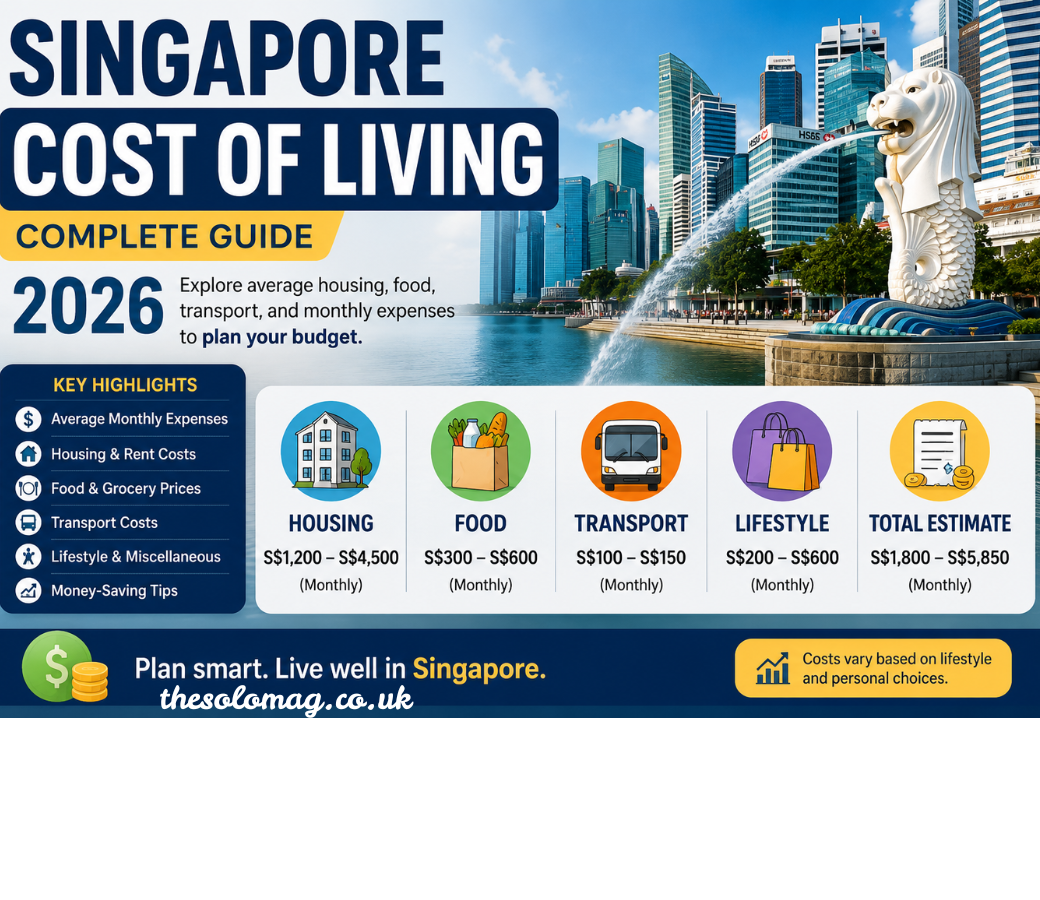
The reality is more nuanced than global rankings suggest. While Singapore cost of Living is undeniably costly in certain areas—particularly housing and car ownership—it offers significant savings in others, such as public transport, income taxes, and hawker centre dining. The cost of living in Singapore is, on average, 41% lower than in New York, according to the Singapore Economic Development Board.
Understanding the true cost of living in Singapore requires looking beyond sensational headlines. This guide breaks down every expense category, compares lifestyle tiers, and provides actionable budgeting advice. Whether you’re planning to relocate, already living here, or simply curious, you’ll find the detailed, data-driven answers you need.
What Is the Cost of Living in Singapore?
The cost of living in Singapore refers to the total expenses required to maintain a certain standard of living in the city-state. In 2026, a single person can expect to spend approximately $1,164 per month (excluding rent), while a family of four requires about $4,216 (excluding rent) . When factoring in rent for a one-bedroom city-centre apartment at an average of $2,676 per month, the total monthly cost for a single person reaches approximately $3,840.
Key Statistics at a Glance:
| Metric | Amount (USD) | Amount (SGD Approx.) |
|---|---|---|
| Average monthly cost (single, no rent) | $1,164 | S$1,560 |
| Average rent (1-bedroom city centre) | $2,676 | S$3,590 |
| Total monthly cost (single, including rent) | ~$3,840 | ~S$5,150 |
| Average monthly net salary | $4,322 | S$5,800 |
| Cost of Living Index (vs New York=100) | 65 | – |
Sources: Wise, Numbeo (2026 data)
Understanding How “Most Expensive” Rankings Work
When you see headlines about Singapore being the world’s “most expensive” city, it’s worth understanding the methodology behind these rankings. The Economist Intelligence Unit’s (EIU) Worldwide Cost of Living survey, for example, weighs prices for over 200 products and services—but does not include tax liabilities, home prices, or rent. It heavily weights items like shopping baskets (25%), transport (19.5%), and recreation/entertainment (18%), which includes green fees on golf courses, car prices, and seasonal clothing.
This methodology works against Singapore’s reality. Green fees are naturally higher in a land-scarce city, and seasonal clothing isn’t needed in Singapore’s tropical climate. Similarly, car prices are high, but public transport is affordable and widely accessible. The survey also converts all prices to US dollars, so a strong Singapore dollar boosts Singapore’s ranking even when local costs haven’t risen.
Why the Cost of Living in Singapore Matters
The Global Context
Singapore tops Asia’s cost of living rankings for 2026, with a Cost of Living Index score of 87.7, compared to New York City’s baseline of 100. Its global standing is significant:
-
5th globally in Numbeo’s Cost of Living Index (including rent)
-
Ahead of London ($4,083/month total) but behind New York ($5,613/month)
-
More expensive than Tokyo ($2,075/month), Sydney ($3,276/month), and Shanghai ($1,541/month)
Economic Drivers
Several structural factors drive Singapore’s elevated cost of living:
-
Land Scarcity: As a compact island nation with finite space, Singapore faces persistent housing supply constraints. The UBS Global Real Estate Bubble Index has ranked Singapore as one of the least affordable cities globally.
-
Import Dependence: Nearly 90% of Singapore’s food supply is imported, exposing consumers to global supply chain disruptions, currency movements, and higher transportation expenses.
-
Strong Currency: A relatively strong Singapore dollar dampens imported inflation but contributes to higher rankings in global cost surveys.
-
High Demand: A growing professional class and consistent expatriate demand keep property prices and rents elevated.
Key Components of the Cost of Living in Singapore
1. Housing (Your Biggest Expense)
Housing consumes the largest portion of most budgets in Singapore. As of 2026, rents have moderated somewhat from their COVID-19 peak but remain 40-50% higher than pre-2022 levels.
Average Monthly Rent (2026):
| Property Type | Suburban/Outside Centre | Prime/Central |
|---|---|---|
| 1-Bedroom Apartment | $1,924 (S$2,580) | $2,676 (S$3,590) |
| 3-Room HDB Flat | $2,300-3,200 (S$3,080-4,290) | $3,800-4,800 (S$5,090-6,430) |
| 1-Bedroom Condo | $3,100-3,900 (S$4,150-5,230) | $4,500-5,800 (S$6,030-7,770) |
| 3-Bedroom Condo | $4,800-6,500 (S$6,430-8,710) | $7,500-10,000+ (S$10,050-13,400+) |
Sources: Wise, TallRock Capital, Crawfort (2026 data)
Key Insights:
-
Renting in the city centre is approximately 30% more expensive than in suburban areas.
-
Neighbourhoods like Farrer Park, Paya Lebar, and Redhill offer city-fringe affordability with excellent connectivity (1-4 MRT stops from the city core).
-
Public housing (HDB) flats provide more affordable rental options, especially for singles.
-
For families with children, neighbourhoods like Ang Mo Kio and Yishun offer more budget-friendly options with good school access.
2. Food and Dining Singapore Cost of Living
Singapore’s food scene offers exceptional variety at every price point. Your monthly food budget depends heavily on where you choose to eat:
| Dining Choice | Cost Per Meal | Monthly (2 meals/day) |
|---|---|---|
| Hawker Centres | SGD 4-6 | SGD 240-360 |
| Food Courts | SGD 7-10 | SGD 420-600 |
| Casual Restaurants | SGD 20-30 | SGD 1,200-1,800 |
| Home Cooking | SGD 3-5 | SGD 180-300 |
Source: Crawfort Singapore (2025 data)
Monthly Grocery Costs:
-
Single person: SGD 300-500 (mix of local produce and some imports)
-
Family of four: SGD 800-1,200
-
Imported specialty items add SGD 200-400 extra
Dining Out Benchmark:
-
Inexpensive restaurant meal: SGD 11-15
-
Three-course meal for two at mid-range restaurant: SGD 67
-
Regular coffee: SGD 5
3. Transportation Singapore Cost of Living
Public transport in Singapore is excellent and affordable—one of the key ways residents keep costs manageable.
Public Transport Costs:
-
One-way MRT/bus fare: SGD 1.49-2.00
-
Average monthly commute: ~SGD 60-100
-
Monthly pass: SGD 100
Compared to other global cities, Singapore’s public transport is significantly cheaper:
-
New York-based subway fare: USD 2.90
-
London peak-hour fares: up to USD 6.06
Car Ownership Costs (2026):
-
Certificate of Entitlement (COE) premium for sedan: >SGD 100,000
-
Monthly cost of mid-range sedan: SGD 2,500-3,500 (including depreciation, insurance, maintenance)
-
Ride-hailing daily use: SGD 600-1,000 monthly (vs SGD 100-150 for public transport)
4. Utilities and Household Bills
Monthly utilities for an 85m² apartment average SGD 154 for electricity, heating, cooling, water, and garbage disposal. The Internet adds approximately SGD 28 monthly.
Typical Monthly Bills:
| Category | Cost (SGD) |
|---|---|
| Electricity + Water | 150-250 |
| Internet | 30-50 |
| Mobile Plan | 20-50 |
| Total | 150-300 |
Source: Crawfort Singapore
Pro Tip: Set air conditioning to 25°C (not 22°C) and use ceiling fans to reduce electricity bills significantly.
5. Healthcare
Singapore’s healthcare system is world-class and highly efficient. While public healthcare is subsidized for citizens, expats typically rely on private insurance or employer-provided coverage.
Cost Considerations:
-
Monthly health insurance premium: SGD 100-200 for basic coverage
-
Private hospital consultation: SGD 80-150+
-
Public hospital subsidized rates available for citizens and PRs
6. Taxes
Singapore’s tax rates are among the world’s lowest, significantly reducing the effective cost of living compared to other global cities.
Personal Income Tax Rates (YA 2024 onwards):
| Chargeable Income (SGD) | Tax Rate |
|---|---|
| Up to 20,000 | 0% |
| 20,000 – 30,000 | 2% |
| 30,000 – 40,000 | 3.5% |
| 40,000 – 80,000 | 7% |
| 80,000 – 120,000 | 11.5% |
| 120,000 – 160,000 | 15% |
| 160,000 – 200,000 | 18% |
| 200,000 – 240,000 | 19% |
| 240,000 – 280,000 | 19.5% |
| 280,000 – 320,000 | 20% |
| 320,000 – 500,000 | 22% |
| 500,000 – 1,000,000 | 23% |
| > 1,000,000 | 24% |
Source: Inland Revenue Authority of Singapore (IRAS)
Key Advantages:
-
Maximum personal income tax: 24% (vs 45% in the UK, 30%+ in the US)
-
No tax on foreign income earned overseas (even if remitted to Singapore)
-
Filing is digital and takes less than 10 minutes if your employer is under the auto-inclusion scheme
Step-by-Step Guide: Planning Your Singapore Budget
Step 1: Determine Your Lifestyle Tier
Your monthly budget will vary dramatically based on your lifestyle choices. Here are three lifestyle tiers to consider:
| Tier | Income (Monthly) | Lifestyle Description | Monthly Budget (Excluding Rent) |
|---|---|---|---|
| Frugal Professional | SGD 2,500-3,500 | Shared HDB room, hawker meals, public transport, minimal entertainment | SGD 900-1,200 |
| Comfortable Executive | SGD 5,000-8,000 | Private apartment (city fringe), mix of hawker & dining, public transport, regular entertainment | SGD 1,500-2,500 |
| High-End Affluent | SGD 10,000+ | Central condo, fine dining, private car, luxury leisure | SGD 3,500-5,000+ |
Source: Crawfort, IPP Financial Advisers
Step 2: Create Your Expense Categories
Fixed Expenses (Non-Negotiable):
-
Rent (30-50% of income)
-
Insurance premiums
-
Loan repayments
-
Utilities
-
Mobile & internet
Variable Expenses:
-
Food (hawker vs restaurants vs home cooking)
-
Transport (public vs ride-hailing)
-
Entertainment and leisure
-
Shopping and personal care
-
Travel
Step 3: Apply the 50/30/20 Rule (Singapore Adaptation)
| Budget Category | Standard | Singapore Reality |
|---|---|---|
| Necessities (Housing, food, transport, utilities) | 50% | 60-70% |
| Wants (Dining out, entertainment, hobbies) | 30% | 15-20% |
| Savings & Debt | 20% | 15-20% |
Source: Crawfort Singapore
💡 Expert Insight: “The 50/30/20 rule is a starting framework, not a rigid mandate. Housing alone consumes 40-50% of take-home pay for renters. This forces adjustments: reduce wants to 20%, increase necessities to 60%, and maintain 20% for savings.” – Crawfort Singapore
Step 4: Calculate Your Upfront Costs Before Moving
If you’re relocating to Singapore, you’ll need significant capital upfront. According to a June 2026 study by Atmos, you need over $10,500 (Sh1.4 million) for the first three months in Singapore :
| Upfront Cost | Amount (USD) |
|---|---|
| Security Deposit + First Month’s Rent | $7,100 |
| Three Months of Living Expenses | $3,400 |
| Total | $10,500 |
Housing alone eats nearly two-thirds of this initial budget.
Best Practices for Managing the Cost of Living in Singapore
✅ Do’s
-
Choose your neighbourhood wisely – Living in suburban areas like Yishun, Punggol, or Ang Mo Kio can save you 30-40% on rent compared to city-centre locations.
-
Embrace public transport – Using MRT and buses costs just SGD 100-150 monthly versus SGD 600-1,000 for ride-hailing.
-
Eat at hawker centres – A SGD 4-6 meal at a hawker centre costs a fraction of restaurant dining.
-
Track your spending – Use apps like Seedly or simple spreadsheets to monitor where your money goes. Many Singaporeans discover that SGD 400 a month disappears into food delivery.
-
Cook at home – Meal-prepping can reduce food costs to SGD 300-500 per month for a single person.
-
Set air conditioning to 25°C – Using ceiling fans and moderate AC temperatures significantly reduces electricity bills.
-
Be strategic with insurance – Compare providers to find the best healthcare coverage that fits your needs.
❌ Don’ts
-
Don’t rent beyond your means – Housing shouldn’t exceed 30-40% of gross monthly income.
-
Don’t rely on private car transport – Unless necessary, the cost of car ownership is prohibitive.
-
Don’t overlook lifestyle inflation – As income rises, avoid increasing discretionary spending proportionally. This is where significant wealth can be built.
-
Don’t neglect retirement planning – Singapore’s high costs make early retirement planning essential.
-
Don’t assume international school fees – If moving with children, research school costs early—they can be the largest expense category.
Common Mistakes When Budgeting for Singapore
🚫 Mistake 1: Underestimating Housing Costs
Many newcomers underestimate how much rent consumes their budget. A city-centre 1-bedroom apartment averaging SGD 3,590 is significantly more expensive than suburban options. Some expats learn this the hard way.
🚫 Mistake 2: Ignoring Upfront Costs Singapore Cost of Living
The security deposit (usually 1-2 months’ rent) plus the first month’s rent requires substantial upfront capital. In June 2026, a newcomer needed over $10,500 just to get started.
🚫 Mistake 3: Thinking Like a Tourist Singapore Cost of Living
Visitors often think Singapore is extremely expensive because they eat at restaurants and take cabs. Residents who eat at hawker centres and use public transport can live comfortably on significantly less.
🚫 Mistake 4: Forgetting About Imported Goods
Most Western staples are available in Singapore, but come with import costs built into the price. Familiar items are often “just pricier”.
🚫 Mistake 5: Not Accounting for Tax Benefits
While Singapore appears expensive on gross cost rankings, the significantly lower tax rates (24% max vs 45% in the UK) dramatically reduce the effective cost of living. Many newcomers fail to factor this into their calculations.
Expert Tips for Living Affordably in Singapore
1. “Live Like a Local”
The EDB’s advice to new residents is simple: “Stash away the suit jackets, lined trousers, and boots. Breathable and functional wear is the daily norm in Singapore”. Avoid the “expat bubble” and embrace local habits.
2. Location Is Everything: Singapore Cost of Living
“The cost of living in Singapore depends greatly on where you choose to live,” advises the Singapore Economic Development Board. City fringe neighbourhoods like Farrer Park and Paya Lebar offer character, history, and affordability within 1-4 MRT stops of the city centre.
3. Understand the “Cost of Quality” Challenge Singapore Cost of Living
As TallRock Capital notes, the “Cost of Living Crisis” of previous years has evolved into a “Cost of Quality” challenge. While commodity prices have stabilized, structural costs like housing and COEs remain high.
4. Avoid the Comfort Zone Trap
For those earning SGD 10,000-15,000, lifestyle inflation is the biggest risk. “This is where lifestyle inflation is the biggest risk,” warns TallRock Capital. “We help ensure their ‘surplus’ is diverted into tax-efficient vehicles like SRS before it’s spent on discretionary luxuries”.
5. Embrace the Cooling Effect
Inflation in Singapore has stabilized at a core rate of 1.3% to 1.5% as of 2026. However, the concentration of costs in essentials like housing and transport continues to challenge even high earners.
Real-World Examples
Example 1: The Frugal Single Professional (SGD 3,200/month)
| Category | Amount (SGD) |
|---|---|
| Rent (shared room, suburban) | 800-1,000 |
| Food (home cooking + hawker) | 400-500 |
| Public Transport | 100-150 |
| Utilities | 150-200 |
| Healthcare & Insurance | 100-200 |
| Entertainment & Misc | 150-300 |
| Total (including rent) | 2,200-2,800 |
Source: Crawfort Singapore
Example 2: The Comfortable Executive (SGD 6,000/month)
| Category | Amount (SGD) |
|---|---|
| Rent (1-bedroom condo, city fringe) | 2,800-3,500 |
| Food (mix of hawker & restaurants) | 600-800 |
| Public Transport + occasional Grab | 200-300 |
| Utilities | 200-250 |
| Healthcare & Insurance | 200-300 |
| Entertainment & Misc | 300-500 |
| Total (including rent) | 4,300-5,650 |
Adapted from various sources
Example 3: The Young Family (Two Adults, One Child, SGD 8,000/month)
| Category | Amount (SGD) |
|---|---|
| Rent (3-room HDB/condo, suburban) | 2,800-3,500 |
| Groceries & Meals | 800-1,200 |
| Transport | 200-300 |
| Childcare | 800-1,200 |
| Utilities | 200-300 |
| Insurance | 300-400 |
| Entertainment & Misc | 300-500 |
| Total (including rent) | 5,400-7,400 |
Source: Crawfort Singapore
Comparison Table: Singapore vs Global Cities (2025/2026)
| City | Total Monthly Cost (1 person) | Rent (1-bedroom, city centre) | Monthly Expenses (no rent) |
|---|---|---|---|
| New York | $5,613 | $3,927 | $1,687 |
| San Francisco | $4,779 | $3,223 | $1,557 |
| London | $4,084 | $2,773 | $1,311 |
| Singapore | $4,053 | $2,922 | $1,131 |
| Sydney | $3,276 | $2,159 | $1,117 |
| Tokyo | $2,075 | $1,113 | $962 |
| Seoul | $1,896 | $823 | $1,073 |
| Shanghai | $1,541 | $924 | $617 |
Source: Numbeo Cost of Living Index (2025/2026 data)
Key Takeaway: Singapore is one of the most expensive global cities, but daily expenses (excluding rent) are comparable to London and Sydney.
Cost of Living in Singapore: Pros and Cons
✅ Pros
| Aspect | Details |
|---|---|
| Low Taxes | Personal income tax capped at 24%; no tax on foreign income |
| Excellent Public Transport | Affordable, efficient MRT/bus network; monthly fares as low as SGD 60-100 |
| World-Class Healthcare | High-quality, accessible healthcare system |
| Food Variety & Affordability | Hawker centre meals from SGD 4-6; world-class culinary diversity |
| Safety | One of the safest cities globally |
| Wages | Average monthly net salary: SGD 4,322 (USD) |
| Tax Efficiency | Digital filing, auto-inclusion scheme, 10-minute tax filing |
❌ Cons
| Aspect | Details |
|---|---|
| Housing Costs | 1-bedroom city centre apartment averages SGD 3,590/month; 40-50% higher than pre-2022 levels |
| Car Ownership | COE premiums exceed SGD 100,000; monthly costs SGD 2,500-3,500 for mid-range sedan |
| Import Dependence | Nearly 90% of food is imported; groceries can be expensive |
| Space Constraints | Small living spaces compared to Western standards |
| Cost of Quality | Premium neighbourhoods and luxury goods come at a premium |
Future Trends in Singapore’s Cost of Living
📈 2026 and Beyond
Inflation:
-
Core inflation has stabilized at 1.3-1.5%
-
Structural costs (housing, transport) remain high
Housing:
-
The rental market has moderated due to increased completed units
-
Prices remain 40-50% above pre-2022 levels
-
Expect continued cooling measures from the government
Transport:
-
MRT network expansion: 50 additional stations expected by 2030
-
COE premiums remain elevated due to the limited supply
Tax:
-
Personal income tax cap of 24% likely to remain
-
Continued favourable tax policies to attract global talent
Economic Outlook:
-
Singapore remains a global financial hub with strong professional demand
-
Median monthly salary is projected to continue rising, particularly for professionals
FAQ Section
1. Is Singapore expensive to live in?
Yes, Singapore is consistently ranked as one of the most expensive cities globally. A single person needs approximately $3,840 per month (including rent) to live in Singapore. However, Singapore is 41% cheaper than New York when comparing the full cost of living.
2. What salary do you need to live comfortably in Singapore?
A comfortable standard of living for a single person requires SGD 5,000-8,000 monthly. Families need SGD 6,500+. The median monthly gross income in Singapore is approximately SGD 5,700 (inclusive of employer CPF).
3. How much does rent cost in Singapore?
A 1-bedroom apartment in the city centre costs an average of SGD 3,590 ($2,676) per month, while outside the centre, it averages SGD 2,580 ($2,054). A 3-bedroom HDB flat in suburban areas costs SGD 2,800-3,500 monthly.
4. How much does food cost in Singapore?
A meal at a hawker centre costs SGD 4-6, while a casual restaurant meal costs SGD 20-30. Monthly grocery costs for a single person range from SGD 300 to 500, while a family of four spends from SGD 800 to 1,200.
5. Is public transport expensive in Singapore?
No, public transport is very affordable. One-way MRT/bus fares average SGD 1.49-2.00. A monthly commute typically costs SGD 60-100. Singapore’s public transport is significantly cheaper than New York or London.
6. How much does a car cost in Singapore?
Car ownership is extremely expensive. Certificate of Entitlement (COE) premiums exceed SGD 100,000 for a sedan. Monthly costs for a mid-range sedan (including depreciation, insurance, and maintenance) total SGD 2,500-3,500.
7. What is the tax rate in Singapore?
Singapore’s personal income tax is progressive, ranging from 0% to a maximum of 24%. This is significantly lower than the UK (45%) and the US (30%+). Income earned from employment outside Singapore is not taxable.
8. How much money do I need to relocate to Singapore?
According to a June 2026 study, you need over $10,500 for the first three months in Singapore, including a security deposit, first month’s rent, and three months of living expenses.
Conclusion
The cost of living in Singapore is undeniably high, but it’s also a more nuanced story than global rankings suggest. While housing and car ownership are among the most expensive in the world, Singapore offers exceptional value in areas like public transport, income taxes, and hawker centre dining. The key to managing the cost of living lies in making strategic choices: live in suburban areas, embrace public transport, and adopt local eating habits.
For professionals considering a move, the low personal income tax rate (capped at 24%) compared to other global cities can offset many of the higher day-to-day expenses. Families should prioritize finding affordable housing in family-friendly neighbourhoods like Ang Mo Kio or Yishun.
In 2026, Singapore remains Asia’s most expensive country to live in, but it also remains one of Asia’s most dynamic and rewarding places to call home. With careful planning and realistic expectations, you can navigate its costs and enjoy everything this remarkable city-state has to offer.
Key Takeaways
| Category | Key Insight |
|---|---|
| Monthly Costs | Single: $3,840 (including rent); Family: $4,216 (excluding rent) |
| Rent | 1-bedroom city centre: SGD 3,590; suburban: SGD 2,580 |
| Food | Hawker centre: SGD 4-6/meal; Groceries: SGD 300-500/month (single) |
| Transport | Public transport: SGD 60-100/month; Car: SGD 2,500-3,500/month |
| Tax | Personal income tax cap: 24% (vs 45% UK) |
| Upfront Costs | $10,500+ for first 3 months |
| Median Salary | SGD 5,700 (inclusive of employer CPF) |
| Savings Strategy | 50/30/20 rule adapted to Singapore (60/20/20) |
Call to Action
Ready to plan your Singapore budget?
-
📊 Calculate Your Costs: Use the data in this guide to estimate your specific monthly expenses
-
🏠 Research Neighbourhoods: Compare rental costs between city centre, fringe, and suburban areas
-
📱 Download Budgeting Apps: Use tools like Seedly or a simple spreadsheet to track your spending
-
📚 Read Official Sources: Visit IRAS for tax information and EDB for relocation resources
-
🔄 Review Your Lifestyle: Identify areas where you can save—from dining choices to transport options
Sources
-
Wise. (2026). “Cost of Living in Singapore 2026 | Singapore Living Costs.”
-
Singapore Economic Development Board. (2024). “What does it really cost to live in Singapore – the world’s ‘most expensive’ city?”
-
Numbeo. (2025). “Cost of Living Index (including rent) – Major Cities.” Cited in Financial Express (2025).
-
TallRock Capital. (2026). “Is Your Salary Enough for Singapore? A 2026 Guide to Cost of Living & Wealth Brackets.”
-
IPP Financial Advisers. (2025). “The Benefits of Starting Retirement Planning Early.”
-
Moneycontrol. (2026). “Singapore is named Asia’s most expensive country to live in 2026.”
-
Crawfort Singapore. (2025). “How the Cost of Living in Singapore Shapes an Average Monthly Budget.”
-
CNBC. (2025). “Here’s how much it can cost for one person to live in 12 major cities globally in 2025.”
-
Atmos. (2026). “Singapore, Sydney, the most expensive cities to restart your life – report.” Cited in The Standard (2026).
-
Global Financial Consultants. (2026). “Moving to Singapore? The Essential 2026 Guide for Aussie Expats.”
FOR FURTHER INFORMATION, VISIT: THESOLOMAG.CO.UK